From Shooting the D1X for National Geographic:
In the summer of 2002, Joe McNally was waging a campaign. He wanted two things - his tenth assignment from National Geographic magazine and permission to shoot it digitally - and he had a good story to help him make his case.
With all of the physical manipulation of lighting and arranging, this is anything but journalism, yet this article still provides insight into the move to digital photography in a publication that treasures photography.

Except for a new removable lense format, Leica has implemented nearly every wish I had into their new Digilux 2 camera that was released this week. Namely the focus, zoom and aperture rings on the lense will give this the feel of a real camera. Playing into the hands of customers like me, they’re marketing it as “the ‘analog’ digital camera”.
There’s been a lot of talk about the new arrangement of features since the press release issued Monday, but all of this talk has everything to do with the perceived user interface since the public hasn’t actually shot with it yet, which shows how critical the camera UI is for serious photographers. It looks like we’ll have to wait ‘til February to get our grubby hands on it to have a look at the image quality. Hopefully the image quality, which was already strides ahead of its class with the Digilux 1, will improve in the same measures as the look and feel of this new camera.
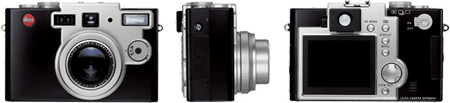
My new camera arrived in the mail early this week. It’s only a few days old and by far the best of the three digital cameras I’ve owned, and in my opinion, the best of any camera in its class. However, I already know that as soon as there’s a substantially better one, preferably one made by Leica, the Digilux 1 will be pushed to the backburner.
First, the good points
- It’s amazingly fast. With manual focus, it takes the picture when the shutter release is pushed. This is unheard of in digital cameras in this price range making it a true “reportage” camera.
- Best automatic exposure of any sub-$1000 digital camera.
- Best color of any sub-$1000 digital camera.
- Manual focus with an actual focus ring.
- Placement of controls and UI make sense and was designed more like a traditional camera.
- Standard flash hot-shoe.
- It’s a beautiful-looking camera. And it’s a Leica.
- When everything’s set to auto, it just takes good pictures and is fast enough to capture the moment. When set to manual focus, manual shutter speed and manual aperture, the photographer has total control.
What I’d like to see in the Digilux 2
- A removable lense format to allow wide angle and telephoto fixed-length lenses.
- A focus ring with increments on the lense. Right now you can’t look at the focus ring and set it for 8 feet. You have to use the viewfinder or digital display to see when it’s in focus.
- F-stop metering on the lense. The aperture is a function of the lense, and that’s where the control belongs.
- Faster image writing. Even though it takes the picture instantaneously (at least with manual focus; a fraction of a second wait with auto-focus), the next shot is delayed for a few seonds while writing the image. Times vary depending on resolution and the size and quality of the card used.
- More pixels. Why not 10 megapixels like the new Leica DIGITAL-MODUL-R?
- Non-retractable lenses. Right now the camera takes a little more than a second to retract the lense when first switched on. Why not turn the camera on, remove the lense cap, and start shooting?
- Better audio reporting — preferably some kind of clicking mimicking an analog camera for when shutter is released, or for long exposures, when the shutter opens and closes. With volume control.
- Some people complain about the camera’s physical size, yet it’s smaller than a Pentax K-1000 with lense. I have no complaint here and have no reservations taking the camera with me everywhere I go.
We took the camera to the ocean yesterday. Here are some of our discoveries.

This is where they make all those trees that you see around the Northwest. These trees need to have their branches and leaves appended and they’ll soon be ready to plant.

Fisherman branding.

Chainsaw carving in Westport.

Oceanside grass.
- The Cross Atlantic Report (CAR) just released their May photos. This is a great idea, and if and when I move to Portugal, I wouldn’t mind participating. One nit: the photos are too small.
- Anything and Everything: a collection of Lomo photographs. Nice display mechanism (and good use of Flash, except you can’t refer to a photograph by its URL).
- The 800x600 Project, where the photographer picks a subject, selects 64 photos, and crams them into an 800x600 grid. My favorite is 64 shots of my workhorse bicycle.
- A few old Adam Curry photographs (one of the original MTV VJs for you American-pop-culture-illterate folk)
- And don’t forget the 10 Golden Rules of Lomography that all farm league photographers should review every now and again (well-designed site, too!)
The same week the LA Times was awarded three Pulitzer Prizes, they talk about their photographer assigned to Iraq who altered a photograph to improve the photograph’s composition. The photoshop-happy photographer was dismissed.
This raises an interesting question for the Times Rights and Permissions FAQ that I stumbled across regarding the licensing of Times’ articles, photos and graphics:
Q: May I alter the photograph or graphic illustration?
A: No, photographs and graphics must be used as published.
Must the licensee use the altered photograph “as published” even though it was altered? You see where I’m going…